"We need a new campaign."
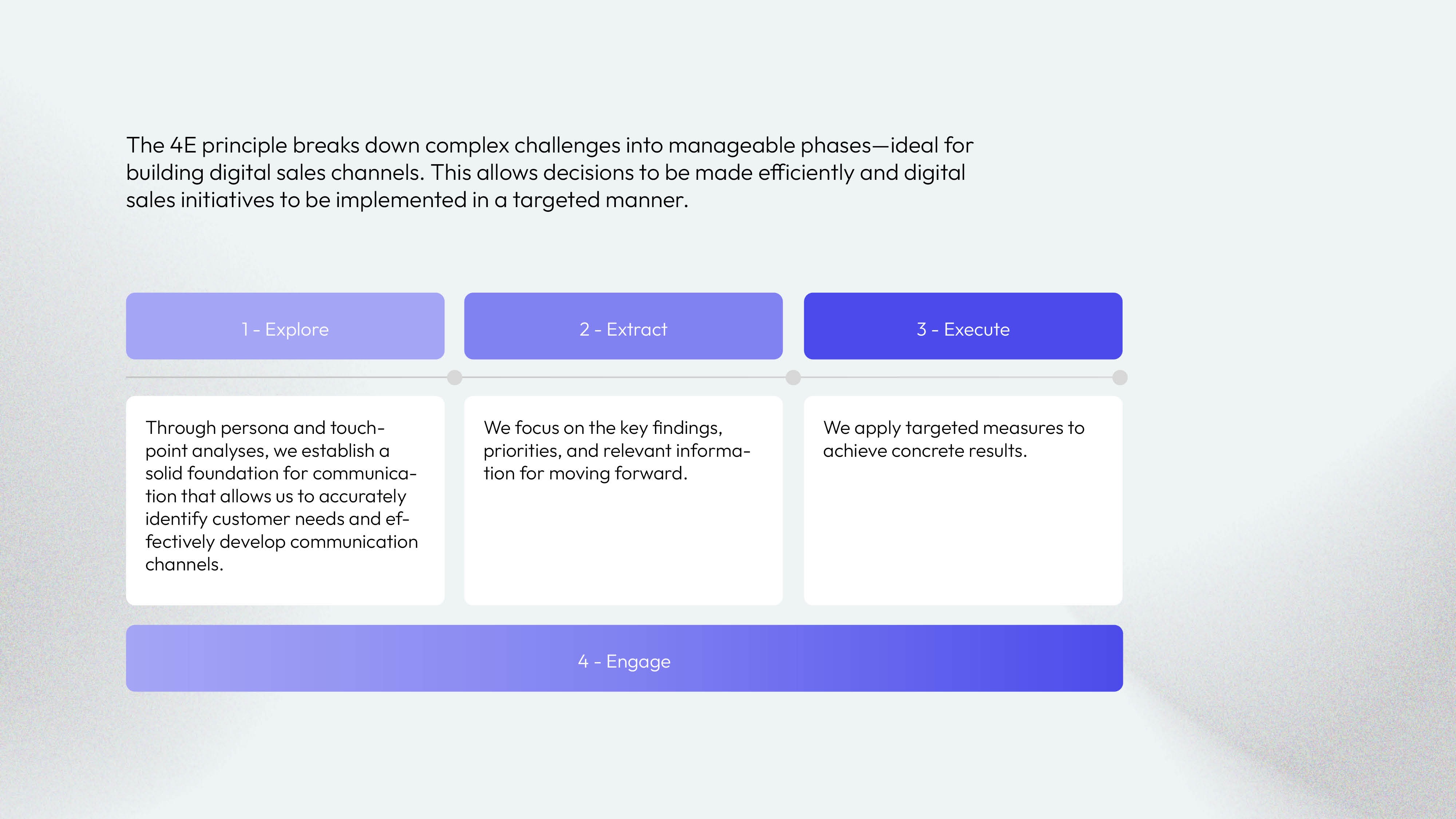
A sentence that triggers a lot in an agency. Because before a briefing turns into an idea, a concept, or a finished campaign, a whole lot happens. At MINT, we have a specific approach for this, which is well described by the following four terms: Explore. Extract. Execute. Engage.
If you look closer, it’s all about one thing: reading, listening, asking, thinking, discussing, experimenting, and constantly searching for the right solution together. But let’s take a closer look. Here we go!
Explore
It starts with reading and listening
For us, a good briefing isn't the signal to jump right in, but the beginning of a collaborative process. We read, listen, and ask questions.
What is the goal? Who do we want to reach? What is the underlying challenge? What makes the company special? And what should the target audience take away from it in the end?
Especially with B2B and industrial projects, there is often a lot to discover. Technical contexts, complex products, established structures, and a wealth of expertise need to be understood first. That’s why we take a closer look, do research, talk to the people who know the company and its products, and try to understand things that might not even be explicitly stated in the briefing.
Explore means for us: diving deep and wanting to understand.
Extract
What’s really behind it?
Eventually, your head is full of information. Now it’s time to filter out what’s important.
Which insights are relevant? Where does the real challenge lie? What message might already be hidden between the lines? And what part of that is actually interesting to the target audience?
A lot of information turns into a clear direction. It’s not about including as much as possible. On the contrary: good communication often happens precisely when you know what to leave out.
Extract means for us: filtering out the most relevant insights from the information.
Execute
And what do we do with it now?
Now it’s time to translate the direction into a concrete solution. This is where the first thoughts, sketches, headlines, layouts, and concepts emerge – sometimes with quite different approaches. We experiment, discuss, discard, and iterate. Because, of course, creativity doesn't just start here. It’s already embedded in the research, the shift in perspective, and the search for that decisive insight. Now, it simply takes on a new form: thoughts become concrete ideas, and ideas become solutions.
The first idea isn't automatically the best one. Sometimes it takes a detour, or even several. Sometimes a discarded idea leads to the next one. Sometimes a small change is all it takes for "not quite there yet" to suddenly become "Yes, exactly like that!"
Execute means for us: turning a clear direction into a solution that works.
Engage
Great communication isn't a solo act
Even if the end result is a finished key visual, a website, or a campaign, the path to getting there is not a one-way street. Feedback is part of it. Discussions are part of it. New perspectives are part of it.
We don't just work on something in isolation and present a finished result at the end. We involve our clients in the process, exchange ideas, and continue to develop the solution together. After all, no one knows a company, its products, and its challenges as well as the people who work there. Our job is to combine that knowledge with our perspective, our experience, and our creativity.
Engage means for us: staying in conversation and developing the best solution by incorporating different perspectives.
And what remains of the briefing in the end?
Perhaps not much. At least not in its original form.
Information, conversations, questions, and thoughts have evolved into an idea. A challenge has become a solution. A briefing has turned into something that is finally visible, understandable, and tangible.
Explore. Extract. Execute. Engage.
Four terms, one process, and a whole lot that happens in between.